
Collaboration in the air
A reflection by Te Wai Collins, Pouārahi Māori, Executive Director Tiriti Partnerships & Māori Success, on her recent trip to Xi'an, China:
Walking around the museum in Xi’an, you are immersed in the long and glorious history of this ancient Chinese city. At the same time, the most poignant part of my short walk was seeing records of the devastation Xi’an experienced in the mid-twentieth century.
I visited Xi’an earlier this month to celebrate the opening of the new Xi’an–Wintec College, our newest Joint Institute in China with Xi’an Aeronautical University, and to acknowledge the first-ever cohort of international students.
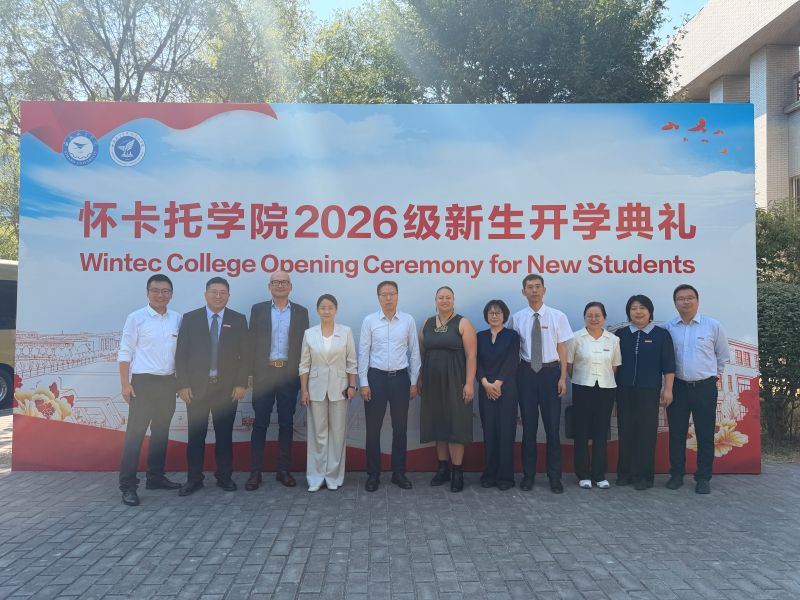 Te Wai Collins joined the opening of the new Xi'an-Wintec College in China.
The College has an approved capacity of up to 1,200 students across three undergraduate programmes: Information and Computing Science, Mechanical Design, Manufacturing and Automation, and Automation. The arrangement allows for up to 300 new students each year, 100 in each programme.
This is a promising start to what we intend to be a longer-term relationship - one that connects education, people, industry, and potentially applied research between China and Aotearoa New Zealand.
We know that Xi’an University has strengths and industry connections in aviation, engineering, advanced manufacturing, and technology. Wintec brings its own applied, industry-connected approach to education.